Tell us about the job
Takes about a minute. No obligation.
Sizing a furnace for a Campbell County home starts with the house itself: its insulation, its air sealing, and how the existing ductwork is laid out. 79 severe weather events were recorded in Campbell County, Kentucky between 2015 and 2024. At that rate, severe weather is real but not the dominant pressure on every installation decision. A contractor quoting the job will spend more time working out what the structure actually holds than accounting for weather load. The duct layout and heat loss of the building are what drive the equipment specification here.
Ductwork laid down for older, lower-output equipment is rarely cut to carry what a new furnace pushes through it. A contractor sizing a replacement here checks the existing runs first, because a system matched to the wrong duct layout will short-cycle or leave rooms cold regardless of how well the unit itself is rated. Half the homes in Campbell County, Kentucky were built in 1972 or earlier (2020-2024 ACS 5-year). That means the plenum, the trunk lines, and the branch sizing are all on the table before any equipment is chosen, and a quote that skips that step is pricing against a guess.
What Gets Installed With a New Furnace
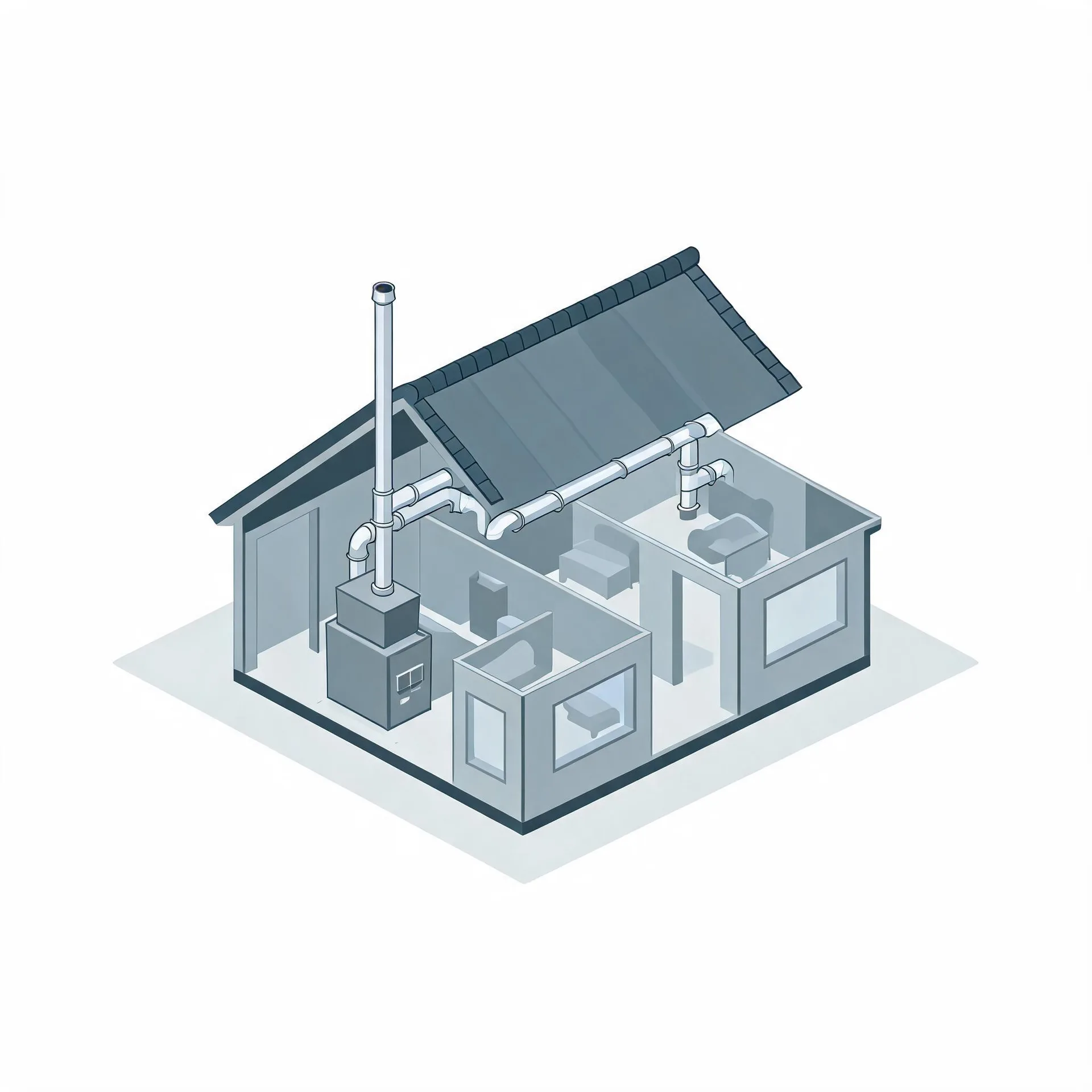
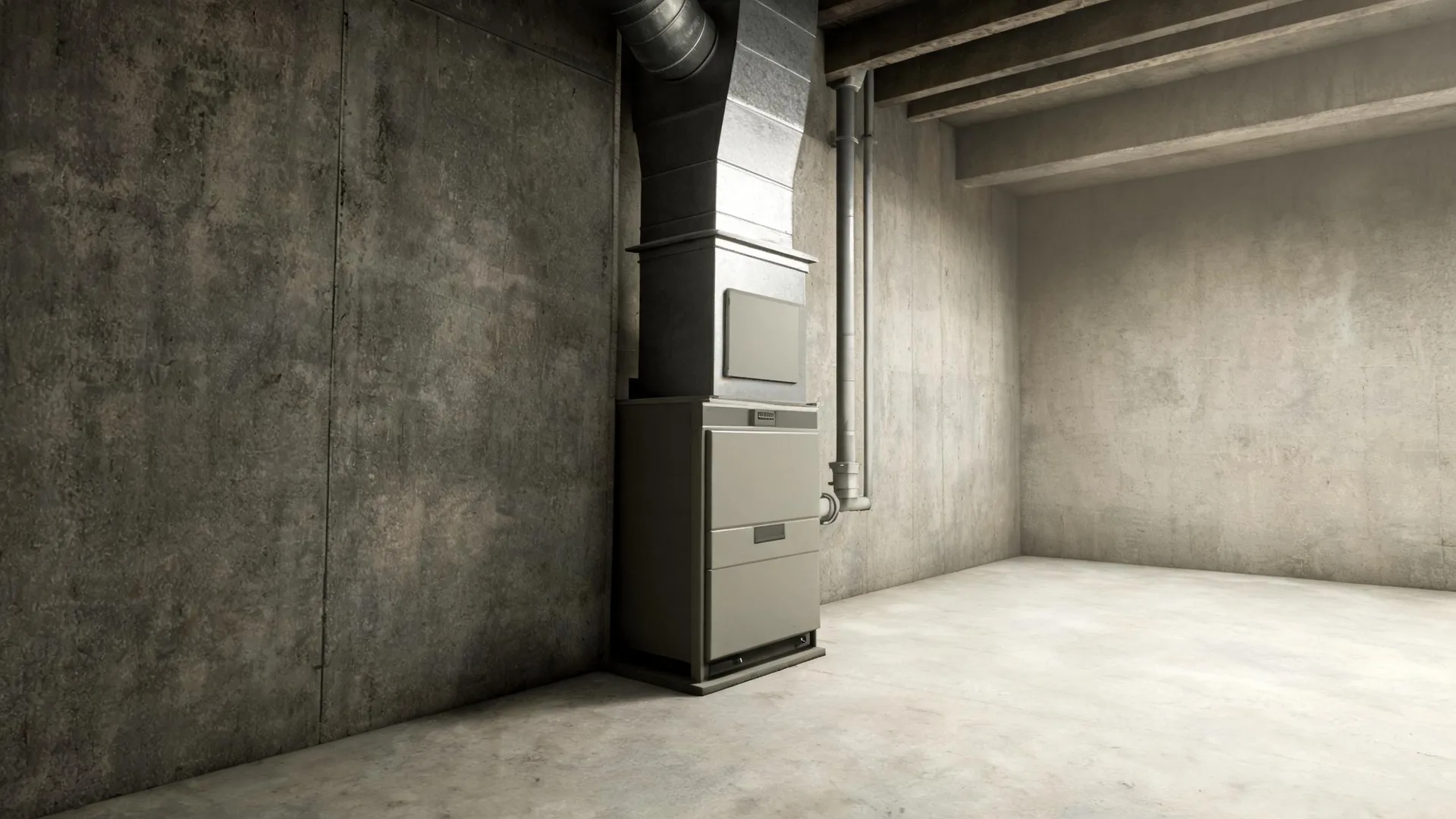
The furnace itself sits in a utility space, most often a basement, closet, or mechanical room. It is the core unit: the burner assembly, the heat exchanger, and the blower all live inside its cabinet. A flue pipe runs from the cabinet to an exterior vent, carrying combustion gases out of the house.
The thermostat mounts on an interior wall and is the control point the household uses every day. A condensate drain line runs from the unit to a floor drain or utility sink when the furnace is a high-efficiency model that produces moisture as part of its operation. Both pieces are part of what a contractor installs alongside the main cabinet.
The drawing shows a typical layout, and a licensed contractor determines exactly what applies to this house based on its construction and existing infrastructure.
Get matched in Campbell CountyCampbell County, Kentucky, by the numbers
79 severe weather events were recorded in Campbell County, Kentucky between 2015 and 2024.
NOAA National Centers for Environmental Information, Storm Events Database, bulk CSV export, events 2015-01-01 through 2024-12-31.Half the homes in Campbell County, Kentucky were built in 1972 or earlier (2020-2024 ACS 5-year).
U.S. Census Bureau, 2020-2024 American Community Survey 5-Year EstimatesCampbell County, Kentucky holds 42,065 housing units (2020-2024 ACS 5-year).
U.S. Census Bureau, 2020-2024 American Community Survey 5-Year EstimatesOwners occupy 71.1% of the occupied homes in Campbell County, Kentucky (2020-2024 ACS 5-year).
U.S. Census Bureau, 2020-2024 American Community Survey 5-Year EstimatesFurnace Installation Rules on the Books for Campbell County, Kentucky5 codes, standards & statutes
What the Installation Actually Looks Like
Non-weatherized gas furnaces manufactured on or after November 19, 2015 must reach 80.0 percent AFUE.
Non-weatherized oil-fired furnaces manufactured on or after November 19, 2015 must reach 83.0 percent AFUE.
Mobile home gas furnaces manufactured on or after November 19, 2015 must reach 80.0 percent AFUE.
Non-weatherized gas furnaces manufactured on or after December 18, 2028 must reach 95.0 percent AFUE, up from the 80.0 percent minimum that applies to units manufactured before that date.
Licensing and Legal Requirements in Campbell County, Kentucky
Kentucky requires a licence to practise heating, ventilation and air conditioning contracting: a person may not do the work unless they have met the state licensing requirements.
Severe Weather Events in Campbell County
Campbell County's weather puts real stress on heating equipment, and that stress compounds over the life of a furnace. How hard a system has to work is a local fact, which is why the installation decisions that matter most here are not the same ones that matter in a milder place.
79 severe weather events, 2015–2024. Source: NOAA National Centers for Environmental Information, Storm Events Database.